GeneraCity: Warsaw | 2026
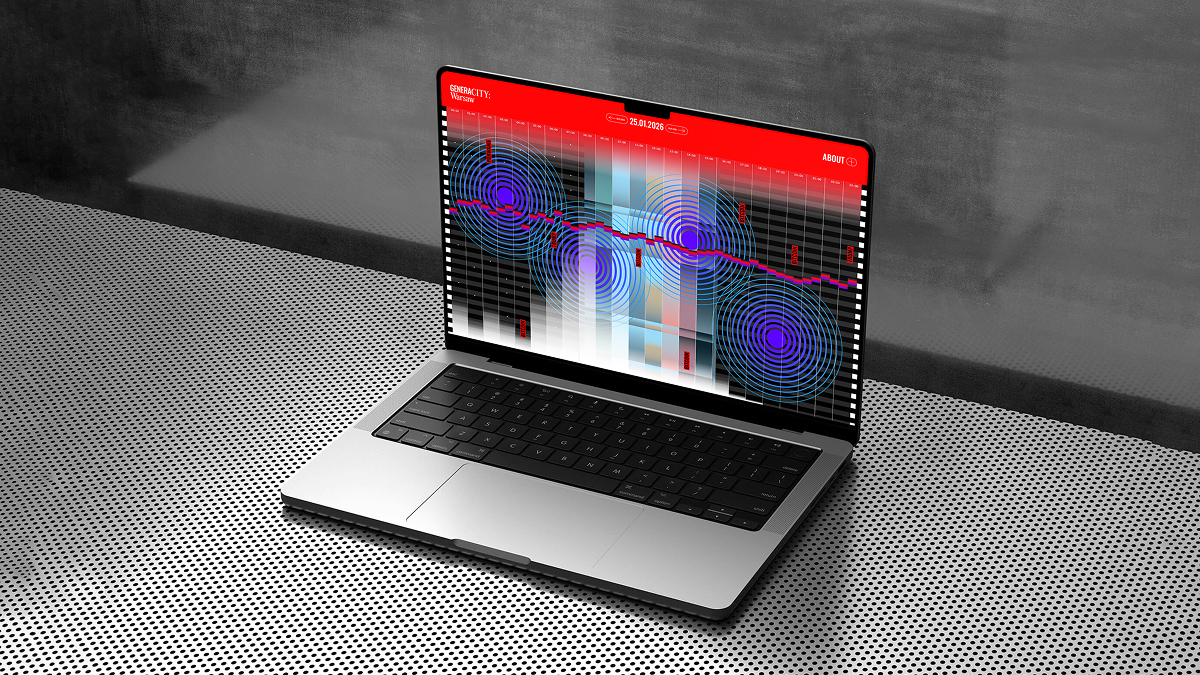
GeneraCity: Warsaw is the first site-specific release of a reusable framework for civic generative art: a system that continuously translates a city’s signals into a living generative process and preserves one autonomous artwork per day as its daily artefact. Developed for Warsaw with Martyna Wędzicka-Obuchowicz (AGI member), it cleanly separates the reusable backend from a locally authored visual layer—so the same engine can be re-instantiated in another city with a different artist, a different medium, and a distinct formal language.
Premise
GeneraCity grows from a poetic suspicion toward language: the way simple nouns (“sea”, “day”, “city”) flatten worlds of detail into stable names. In the sea at noon: photographing the same, I returned to the same point for a year and photographed the sea with the same setup, exposing how the category “sea” contains endless difference. GeneraCity extends that inquiry from the visible surface to the city’s data layer—its measurements, flows, and signals—using them as generative material to produce an autonomous artwork rather than an explanatory visualisation.
In this sense, the project aligns with Olafur Eliasson’s recent drawing-machine observatories—especially Solar-drawing observatory (Small spheres), 2023 and Weather-drawing observatory for the future, 2024—where an external system (sun, weather, time) becomes the authoring force behind a daily image. GeneraCity adopts a comparable logic, but shifts the driver from climate and light to the city’s own telemetry and narratives, and pushes it toward the kind of heightened, totalised data experience associated with Ryoji Ikeda’s data-cosm work: data not as information to be read, but as material to be felt.
Protocol
The system continuously ingests heterogeneous city data—astronomical parameters (sunrise/sunset), meteorology (temperature, precipitation), hydrology (river level and flow), air quality, and the daily narrative layer of local news (topics and keywords). It can also read the city’s own optics, such as sampling sky colour from municipal cameras. These inputs are composed into a single daily artefact anchored in the city’s atmosphere, rhythms, and attention economy.
Rather than treating the city as a set of static datasets, GeneraCity distinguishes between continuous observations and events. Measurements such as weather, air quality, hydrology or transport rhythm modulate the work over time, while disruptions, alerts and media signals can act as triggers: moments of tension, interruption or shift. The daily local news layer is treated in the same way—not as content to be republished, but as a semantic signal of the city’s attention: topics, tone, density and informational pressure are transformed into synthetic indices that can influence the behaviour of the work.
The system is designed to operate in a near real-time mode, but not by regenerating a complete image from scratch at every change. Incoming data are normalised, smoothed and translated into a limited set of stable control parameters. AI is used selectively, primarily where the input is textual or semantic, while numerical streams remain governed by explicit transformations. This keeps the work responsive without turning it into a chaotic dashboard or an opaque AI image generator.
This is not data visualisation in the usual sense. Even if GeneraCity borrows some of the grammar of plots or dashboards, its goal is not legibility or explanation. The data function as generative constraints and collaborators—driving form, tension, and coherence—so the output stands as an artwork first, and only secondarily as a trace of measurements.
Authorship sits at the level of the ruleset. The visual artist does not arrange fixed elements into a static composition; instead, they define how variables become structure: mappings, thresholds, weights, transformations, constraints, and the overall aesthetic protocol. The system then runs independently, producing daily instances that are outcomes of a designed grammar rather than manually authored frames.
Finally, site-specific here means more than a new surface. Each instantiation can choose its medium: Warsaw currently develops toward a two-dimensional image language, but another city could output a 3D model on screen, a 3D-printed object, a video, an audio composition, or any hybrid of these. Any medium that can be generated from a dated dataset—capturing a day, a week, or a season—can become the carrier of that city’s version of GeneraCity.